Justification by the Word

“The word of the LORD came to Abram in a vision, saying,
“Do not fear, Abram,
I am a shield to you;
Your reward shall be very great.”
Abram said, “O Lord GOD, what will You give me, since I am childless. Then behold, the word of the LORD came to him, saying… “one who will come forth from your own body, he shall be your heir.” And He took him outside and said, “Now look toward the heavens, and count the stars, if you are able to count them.” And He said to him, “So shall your descendants be.” Then he believed in the LORD; and He reckoned it to him as righteousness.” — Genesis 15:1-2,4-6
***
“The word of the LORD came to a man baptized in the Name of the Father and the Son and the Holy Spirit, in the liturgy of the Word on Sunday morning, saying,
“Do not fear my beloved one,
I am a shield to you;
Your reward shall be very great.”
And the baptized man said: “O Lord GOD, I believe, but help my unbelief in an ever-increasing world of faithlessness.” Then the Lord came to him in the liturgy of the Eucharist, and He said: “take, eat and drink, this is my body and blood given personally for you as a tangible sign of my love and affection for you.”
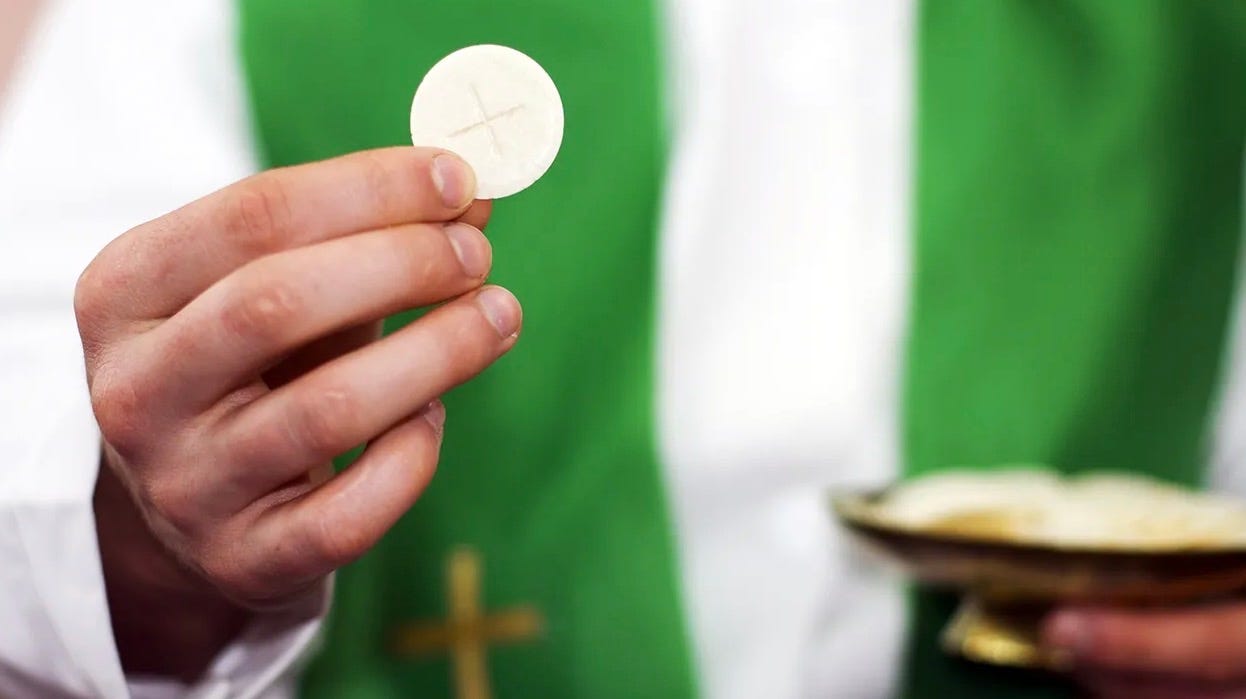
Then the man believed in the Lord’s promise; and the Lord reckoned it to him as righteousness.”
Reflection:
“The sacrament of the Eucharist (and by implication Baptism as well), confirms for the individual what the Word universally proclaims. The word of the gospel is addressed to everyone in the congregation, and therefore it is possible to worry that this promise may not apply to you as an individual, or you have not genuinely received it by faith. Nevertheless, the Lord’s Supper contains within it the same promise and presence of the risen Jesus as the sermon. Words are sacraments and sacraments are a kind of word. The difference between the sermon and the sacrament is that the latter is applied to the individual who directly receives it. When reflective faith invariably worries about whether or not one has individually received Jesus and his promise of forgiveness, the believer may rely on the sacraments to give them assurance. There can be here no doubt that you have personally received the promise in the form of the sacrament since it was you as an individual who heard the promise and consumed the elements. By receiving the Eucharistic elements, the promise and presence of Jesus are given to you in a tangible and physical way that draws you out of your subjectivity and enthusiasm (Did I truly believe? Did I truly receive the promise?) to the objectivity of the gospel.”
“The word of justification is objectified in both in preaching and the sacraments in such a way as to shift the focus from authentic appropriation of God’s grace to the question of the surety of God’s promise. Since the risen Jesus is genuinely present in the means of grace, he is capable of mediating a direct assurance of his justifying grace for sinners who look for him there. The tendency of believers to reflect upon and worry about the authenticity of their faith is a sinful resistance to Jesus’s promise that they have already been accepted. Therefore, instead of “justification through faith” it might be appropriate to speak of this as “justification by the Word.”
“This (Word of Promise) has been neglected and misunderstood by Protestants and Catholics alike, “justification by the Word” is a better model for understanding salvation in Christ. This is not only the case because it is more faithful to the teachings of the Scriptures, but also because it is the only doctrine of salvation that fully succeeds in de-centering the self and overcoming the self-incurvature of sin (incurvatus in se). As Martin Luther himself observes in his Galatians commentary of 1531: “This is the reason why our theology is certain, it snatches us away from ourselves and places us outside ourselves, so that we do not depend on our own strength, conscience, experience, person, or works but depend on that which is outside ourselves, that is, on the promise and truth of God, which cannot deceive.” - Jack Kilcrease (Justification by the Word